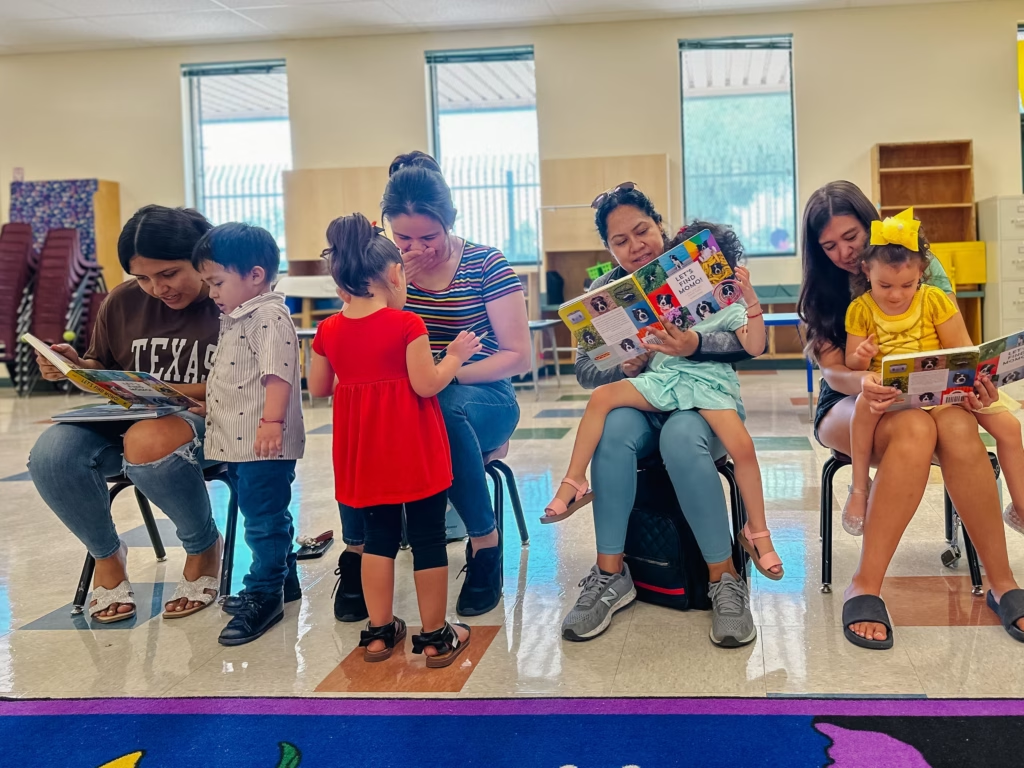
Your child’s language development begins long before they can talk or spell. It begins with them being sung, read and talked to.
“Children begin building the language skills that prepare them to read and write from birth to age 5,” says Cynnamon Woodberry, Associate Director of Stewardship at Make Way for Books. “When we help children unlock language at a very young age, the world becomes more accessible for them.”
Help build your child’s language skills through simple activities that are already a part of your life.
1. Use labels.
While on a walk or running errands, talk about the world around you. “This is a ladybug.” “That’s a cactus. It has spikes to protect itself.”
2. Add details to conversations.
If your child says, “I want that cereal,” you can say, “OK, you want that cereal, and that box is red.”
3. Extend language in conversations.
Young children have yet to learn grammar rules, but you can build those skills by acknowledging them and adding on. “When you model conversation, children will start to practice how to use language in conversation,” Woodberry says.
Your child might say, “Mommy, hungry.” In response, you could say, “Oh, are you very hungry? Let’s get you some carrots.”
4. Answer questions.
“Kids are curious. The world is all new to them,” Woodberry says. “Answering their simple questions with approachable language is a great way to develop language and vocabulary.”
5. Sing along to daily activities.
Woodberry’s mom sang to her about the meals she was cooking in the kitchen and how much they loved to eat vegetables.
“I remember that song to this day,” she says. “Small interactions like these are what help children learn how to read and talk.”
6. Describe what you’re doing.
Whether it’s the process of changing a baby’s diaper or cleaning the house, talk about what you’re doing. Discuss what you see, feel and do, and give words to the sounds. Every detail helps build language.
7. Use rhymes and activities.
Simple rhymes like Pat-a-Cake and books that incorporate songs are easy literacy activities for toddlers that help reinforce language and make it fun.
“Children’s songs are repetitive for a reason,” Woodberry adds. “It’s so that children can start to learn the cadence of language.”
8. Connect images in books with words.
For example, if there’s a lion in a book, ask your child to point it out. Then, have them roar like a lion.
9. Use games.
Use the power of play to support your toddler’s language development. You can play “I Spy” in the car or choose a color or an item of the day for them to call out throughout the day.
10. Tell family stories.
Look at family pictures together and share stories about the people in the pictures. It’s a way to connect language and story without a book.
11. Read together.
“Read books as much as it’s joyous for you and your child,” Woodberry says. “It’s a great way to make deep connections with your kids.”
Download Our Free App
Find books and make joyful connections with your children on the free Make Way for Books app!
More News & Stories